From Obligation to Consequence
The EU Pay Transparency Directive (Directive (EU) 2023/970) introduces a comprehensive framework for pay transparency across recruitment, employment, reporting, and remediation. However, the effectiveness of these obligations ultimately depends on how they are enforced.
Article 10 establishes the enforcement architecture of the Directive, ensuring that rights granted under earlier provisions are supported by meaningful remedies and consequences.
This provision transforms the Directive from a set of procedural requirements into a legally enforceable framework with tangible risks for non-compliance.
The Enforcement Framework — An Overview
Article 10 requires Member States to ensure that employees have access to judicial and administrative procedures, effective remedies are available for breaches of equal pay rights, and penalties are applied where obligations are not met.
Effective
Mechanisms must genuinely deter and remedy non-compliance
Proportionate
Penalties must reflect the nature and scale of the breach
Dissuasive
Consequences must be sufficient to change behaviour
Employee Rights to Remedy
Employees who experience pay discrimination or lack of compliance with the Directive are entitled to seek remedies.
Types of Claims
Employees may bring claims related to:
- Unequal pay for equal work or work of equal value
- Failure to provide required pay information
- Non-compliance with reporting or transparency obligations
Access to Procedures
Member States must ensure that employees can:
- Access courts or competent authorities
- Seek remedies without undue barriers
- Be protected from retaliation
The Shift in Burden of Proof
One of the most significant aspects of Article 10 is the reversal of the burden of proof.
Traditional Approach
The employee must prove discrimination — placing the full evidentiary burden on the individual bringing the claim.
Article 10 Approach
Once an employee establishes facts suggesting pay inequality, the employer must prove that no discrimination has occurred.
Critical Implication
This places the responsibility on employers to demonstrate that pay differences are justified using documented, objective, gender-neutral criteria. Without this documentation, employers have no defence.
Compensation for Employees
Employees who successfully bring claims are entitled to full compensation.
Scope of Compensation
Compensation may include:
- Recovery of unpaid wages
- Bonuses and benefits
- Compensation for lost opportunities
- Interest on delayed payments
Key Principle
Compensation must fully restore the employee to the position they would have been in absent the discrimination. It is not subject to arbitrary caps or limitations.
Penalties for Non-Compliance
Article 10 requires Member States to introduce penalties for breaches of the Directive.
Types of Penalties
Financial Fines
Monetary penalties scaled to the nature and duration of non-compliance
Administrative Sanctions
Regulatory actions by designated enforcement bodies
Public Disclosure
Public naming of non-compliant organisations by authorities
Factors Influencing Penalties
The severity of penalties may depend on:
- The extent of non-compliance
- The duration of the breach
- The size of the organisation
- Previous violations
Role of Equality Bodies and Authorities
Member States must designate bodies responsible for supporting employees in claims, monitoring compliance, and investigating potential breaches.
Guidance
Providing guidance to both employers and employees on compliance requirements
Dispute Resolution
Assisting in resolving pay disputes before they reach formal legal proceedings
Investigations
Initiating investigations where systematic non-compliance is suspected
Protection Against Retaliation
Employees exercising their rights under the Directive must be protected from dismissal, disciplinary action, or any form of adverse treatment.
Practical Implications
Employers must ensure that:
- Internal policies protect whistleblowers
- Managers are trained to handle requests appropriately
Evidence and Documentation Requirements
Given the burden of proof shift, employers must maintain clear records of pay decisions, documentation of pay criteria, and evidence supporting pay differences.
Key Risk
Without documentation, employers may be unable to defend against claims or demonstrate compliance. In a reversed burden of proof environment, silence equals liability.
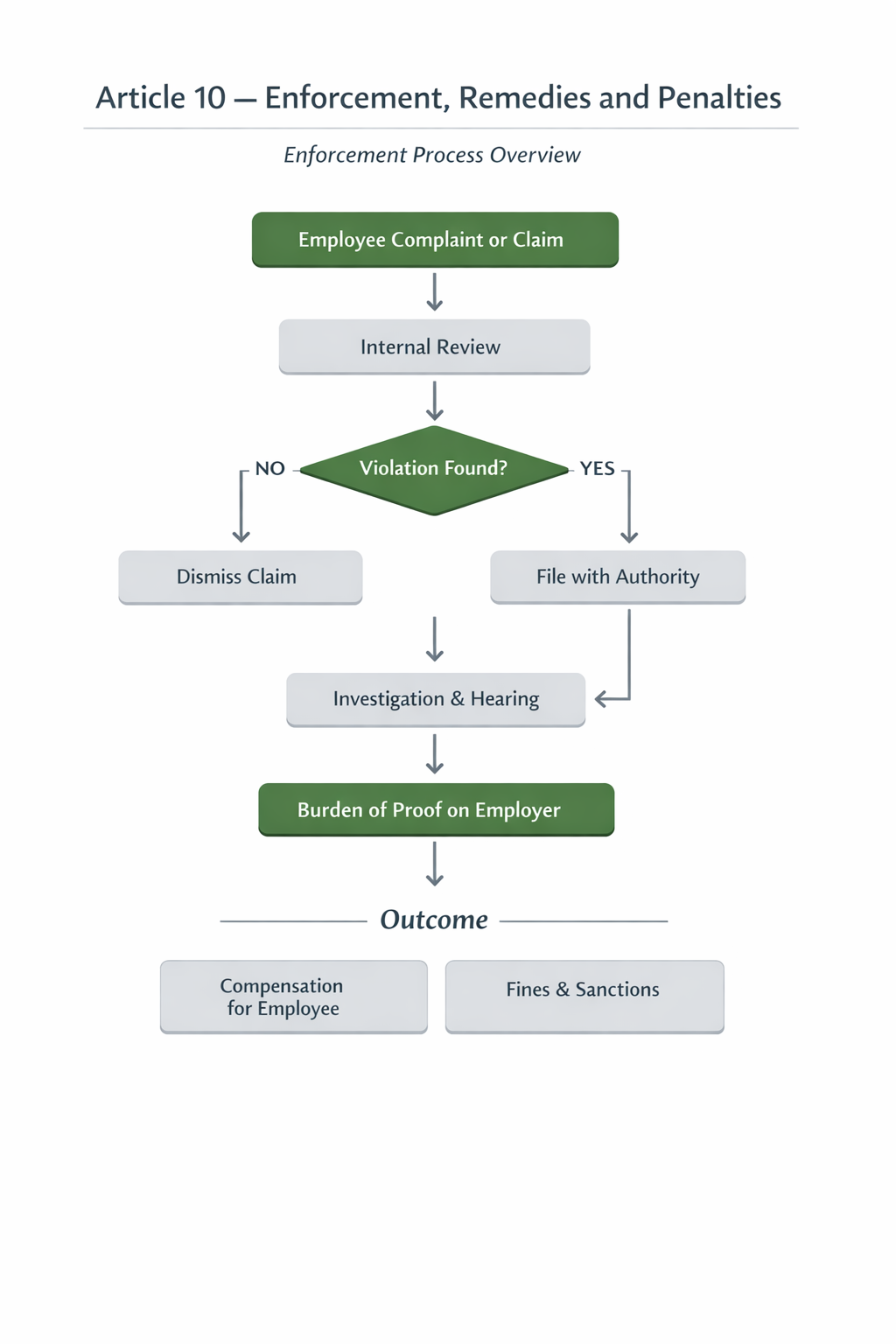
Article 10 Enforcement Flow
From Claim to Outcome
Employee identifies potential pay inequality and raises a claim
Employee establishes facts suggesting discrimination — burden shifts to employer
Employer must provide documented evidence of objective, gender-neutral justification
Court or competent authority assesses the evidence and determines outcome
Full compensation awarded and/or penalties applied where non-compliance is found
Documentation and structured processes are the employer's primary line of defence at every stage.
Link to Earlier Articles — A Connected Framework
Article 10 is closely linked to every earlier provision. Failures in any of these areas may lead to enforcement action.
Salary transparency in recruitment
Art. 6Employee access to pay information
Art. 7Gender pay gap reporting obligations
Art. 8Joint pay assessments and corrective action
Art. 9Data protection safeguards
Practical Implementation — A Step-by-Step Approach
Review Compliance Across Articles
- Assess readiness for Articles 5–9
- Identify gaps before enforcement begins
Strengthen Documentation
- Record pay decisions and criteria
- Maintain audit trails across the organisation
Define Internal Processes
- Establish procedures for handling complaints
- Ensure consistency in responses
Train Leadership and HR Teams
- Build awareness of legal risks
- Ensure proper handling of requests and claims
Monitor and Improve
- Conduct regular compliance reviews
- Address emerging risks proactively
Common Pitfalls and Risks
Lack of Documentation
Inability to justify pay decisions means employers cannot discharge the reversed burden of proof, making successful claims significantly more likely.
Misunderstanding the Burden of Proof
Assuming employees must prove discrimination leads to inadequate preparation. Under Article 10, the employer must disprove it once basic facts are established.
Inadequate Internal Processes
Poor handling of employee requests or complaints increases the likelihood of escalation into formal legal claims that could have been avoided.
Weak Governance
Lack of oversight and inconsistent practices create systemic vulnerabilities that regulators and enforcement bodies are well-positioned to identify.
Strategic Implications of Article 10
Increased Legal Risk
- Greater likelihood of claims
- Higher financial exposure
Proactive Compliance
- Reactive approaches are insufficient
- Early preparation significantly reduces risk
HR & Legal Integration
- Closer collaboration required
- Alignment on policies and practices
Key Takeaways
- Article 10 establishes enforcement and legal consequences under the Directive
- The burden of proof shifts to employers in pay discrimination cases
- Employees are entitled to full compensation without arbitrary caps
- Penalties must be effective, proportionate, and dissuasive
- Strong documentation and structured processes are the primary line of defence
Conclusion — The Directive as an Integrated System
The EU Pay Transparency Directive operates as a connected framework — not a collection of isolated obligations. Transparency in hiring, access to information during employment, structured reporting, mandatory remediation, data protection safeguards, and enforceable consequences are all interdependent.
Organisations that treat these elements in isolation may face increased risk. Those that approach the Directive as an integrated system are better positioned to achieve both compliance and long-term pay governance stability.
Prepare before enforcement begins.
GenderGov™ helps organisations build the documentation, processes, and pay governance infrastructure needed to meet every Article 10 obligation — before a claim is ever raised.
Talk to Us