This guide focuses on employer preparedness for EU pay transparency — from data and worker-category readiness to reporting, documentation and governance. For the underlying legal obligations and Article-by-Article breakdown, see the Employer Legal Obligations & Compliance Framework.
The EU Pay Transparency Directive (Directive (EU) 2023/970) marks one of the most significant shifts in employment regulation across Europe in recent years. The Directive's transposition deadline was 7 June 2026. With implementation now progressing unevenly across Member States, employers should focus not only on national transposition timelines, but on whether their data, pay structures and reporting processes are operationally ready.
What makes this Directive uniquely complex is not just the requirement to disclose pay information, but the expectation that organisations can justify, structure, and defend their pay decisions when challenged. Compliance is no longer a matter of policy documentation alone — it is a matter of operational readiness.
Many organisations already hold the necessary data. However, very few are currently in a position where that data can be:
- Retrieved consistently
- Structured into required reporting formats
- Explained using gender-neutral criteria
- Defended under scrutiny
This guide outlines how employers can move from awareness to readiness — focusing not on redesigning pay structures, but on ensuring that reporting, documentation, and governance are aligned with the Directive.
Why This Matters Now
The Directive introduces a fundamental shift: pay transparency moves from internal discretion to enforceable employee rights.
Employees will have the right to:
- Their individual pay level
- Average pay levels, broken down by sex, for categories of workers performing the same work or work of equal value
- Additional reasonable clarifications where the information provided is inaccurate or incomplete
At the same time, employers will face:
- Mandatory reporting obligations
- Increased scrutiny from regulators and employees
- Potential reputational and financial risk
The risk is not limited to non-compliance. It extends to inability to explain. An organisation may have fair pay structures in practice — but without the ability to clearly demonstrate how roles are evaluated, how pay levels are determined, and why differences exist, it will still be exposed.
The Directive is not only about what you pay, but how well you can explain it.
From Data to Defensible Reporting: A Practical Readiness Flow
Preparing for EU Pay Transparency is not a linear exercise. Organisations must move from fragmented data to structured, defensible reporting through a series of coordinated steps.
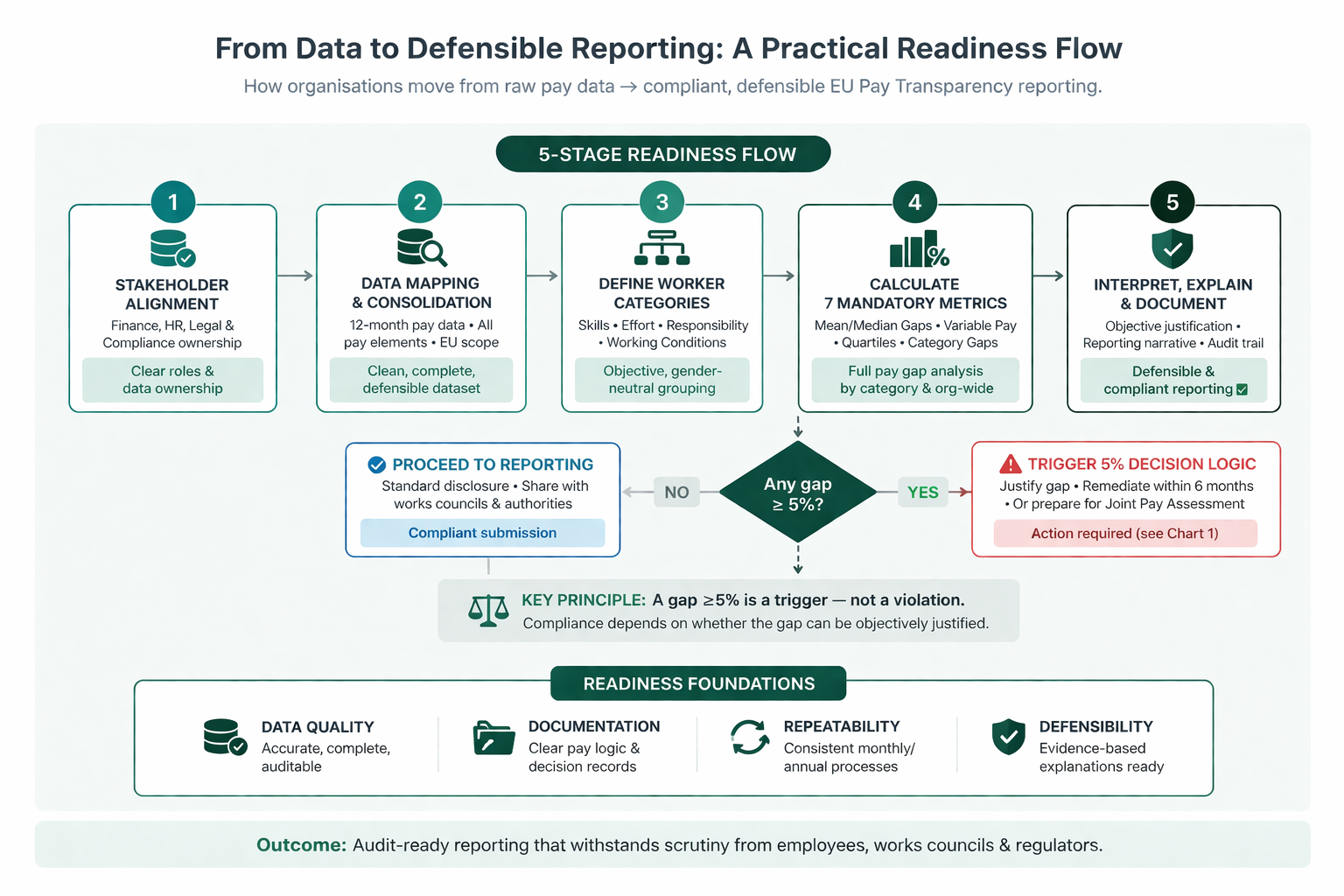
Compliance is not achieved at the point of calculation, but at the point of explanation.
Stakeholder Alignment and Ownership
Identify the functions responsible for:
- Payroll and compensation data
- HR systems and employee records
- Legal and compliance interpretation
In many organisations, this data sits across multiple systems and geographies. Without clear ownership, even basic reporting becomes inconsistent.
Data Mapping and Consolidation
The Directive requires a comprehensive view of pay, including:
- Base pay
- Complementary and variable components
- Benefits and allowances
The challenge is rarely absence of data — it is fragmentation. Organisations must ensure:
- Consistent definitions across countries
- A 12-month reference period
- Inclusion of all relevant pay elements
Defining Worker Categories
A central concept in the Directive is ‘equal pay for equal work or work of equal value.’ Pay structures must enable the value of work to be assessed using objective, gender-neutral criteria, including:
- Skills
- Effort
- Responsibility
- Working conditions
Where appropriate, other factors relevant to the specific job or position should also be taken into account.
These categories must be objective, gender-neutral, and consistently applied. Poorly defined categories can lead to misleading pay gap results — and increased risk.
The quality of worker category definitions directly determines the reliability of every metric that follows.
Pay Gap Measurement Across Required Metrics
Employers will be required to calculate and report multiple pay gap indicators across the organisation and within worker categories. This step is not just analytical — it is diagnostic. It answers where gaps exist, how significant they are, and which employee groups are affected.
Interpretation, Documentation, and Readiness
Beyond calculating metrics, employers must be able to:
- Interpret results in context
- Document underlying pay logic
- Prepare explanations using objective factors
Compliance is achieved not at the point of calculation, but at the point of explanation.
The Seven Pay Gap Reporting Metrics under Article 9
For employers subject to the Directive's pay-reporting requirements, Article 9 specifies seven categories of information to be reported:
- Mean gender pay gap (total pay)
- Median gender pay gap (total pay)
- Mean gap for variable or complementary components
- Median gap for variable or complementary components
- Proportion of employees receiving variable pay (by gender)
- Gender distribution across pay quartiles
- Pay gaps within each category of workers
These metrics together form a compliance narrative, not just isolated data points.
Understanding the 5% Threshold and Risk Trigger
One important threshold under Article 10 is a difference of at least 5% in the average pay level between female and male workers within a category of workers. The 5% difference alone does not automatically require a Joint Pay Assessment; the other Article 10 conditions must also be met.
However, not all gaps automatically indicate non-compliance. The key question becomes:
Can the difference be justified on the basis of objective, gender-neutral criteria?
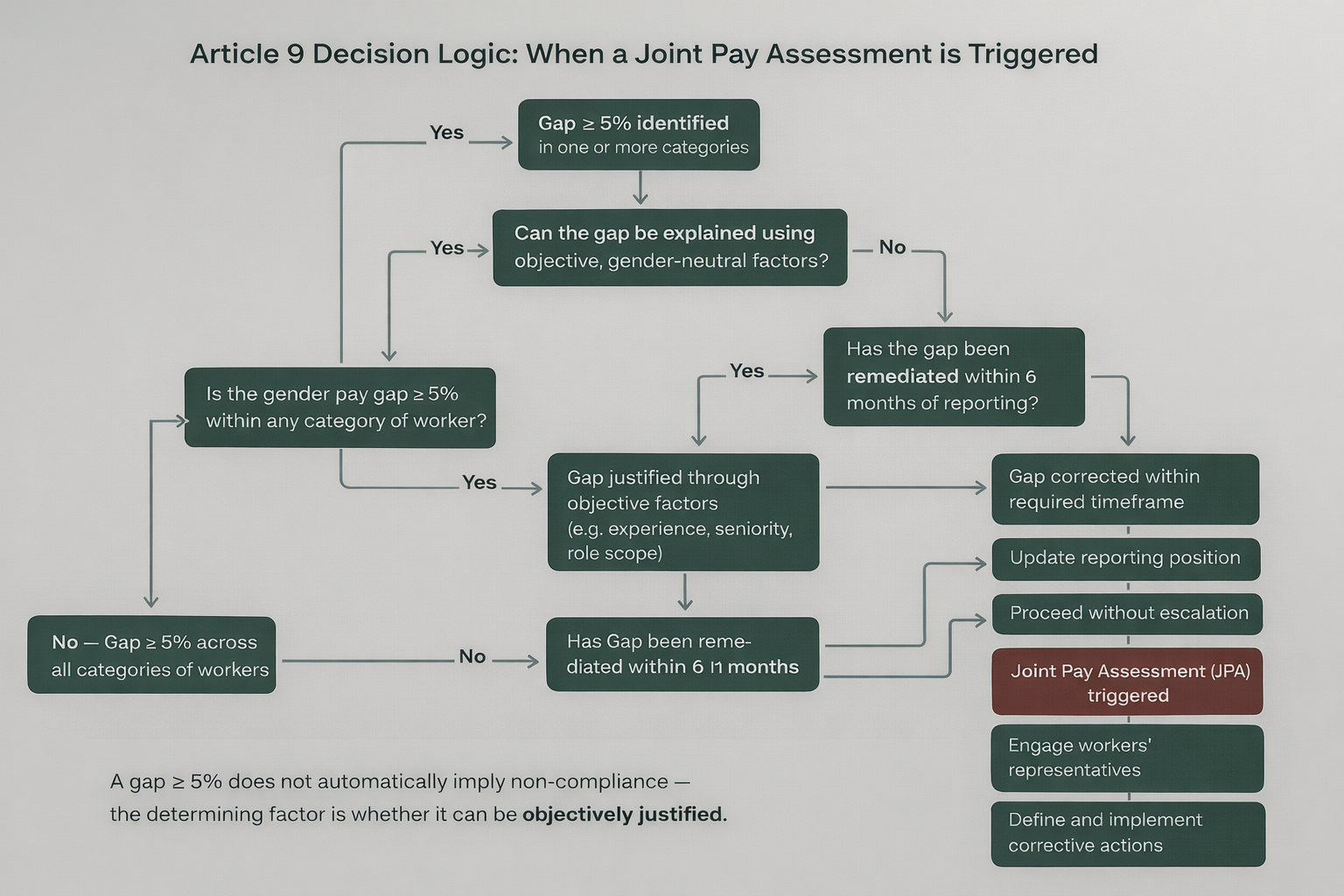
A gap ≥5% does not automatically imply non-compliance. The determining factor is whether it can be objectively justified.
Joint Pay Assessments: When Compliance Becomes Intensive
Under Article 10, a Joint Pay Assessment is required for employers subject to Article 9 pay reporting where all three conditions are met:
- Pay reporting demonstrates a difference of at least 5% in the average pay level between female and male workers in a category of workers
- The employer has not justified that difference on the basis of objective, gender-neutral criteria
- The employer has not remedied the unjustified difference within six months of submitting the pay report
Employers must work with employee representatives to:
- Analyse pay differences
- Identify root causes
- Define corrective actions
This introduces operational complexity, legal exposure, and reputational risk.
Bridging the Gap: Raw vs Adjusted Pay Analysis
A critical distinction in pay gap analysis is between:
- Raw (unadjusted) gaps — surface-level differences across the organisation
- Adjusted gaps — gaps after accounting for role characteristics, experience levels, and organisational structure
Raw and adjusted analyses can help employers investigate the factors behind observed pay differences. For Article 10 purposes, however, the relevant question is whether a difference in average pay levels can be justified on the basis of objective, gender-neutral criteria.
Common Readiness Gaps Across Organisations
Across industries, several patterns are consistently emerging:
1. Data Exists, But Is Not Structured
Organisations often have the data required, but not in a format suitable for reporting. Fragmented HR systems, inconsistent definitions, and missing reference period data are the most common barriers.
2. Worker Categories Are Inconsistent
Different regions or departments may use different classification logic, producing results that are incomparable and difficult to defend.
3. Pay Logic Is Not Documented
Decisions may be fair in practice, but lack the formal documentation required to explain them under scrutiny. Without written criteria, justification is impossible.
4. Reporting Is Not Repeatable
Ad hoc analysis may produce results for one cycle, but cannot scale across reporting periods or geographies without a structured process.
5. Explanations Are Not Standardised
Different stakeholders may interpret results differently. Without standardised language and criteria, the organisation cannot give consistent answers to employee or regulator questions.
What This Means for Employers
The Directive signals a broader shift in how pay is managed and communicated. Employers must move towards:
- Structured pay frameworks
- Transparent communication
- Consistent documentation
- Repeatable reporting processes
Compliance does not necessarily require immediate pay restructuring.
Clarity, consistency, and defensibility — these are the foundation of readiness.
Conclusion
The EU Pay Transparency Directive is not simply a regulatory requirement — it is a shift in how organisations are expected to manage and communicate pay.
Preparedness will not be defined by whether data exists, but by whether it can be:
- Structured
- Explained
- Defended
The organisations that succeed will be those that treat this not as a compliance burden, but as an opportunity to build stronger, more transparent pay governance.
Preparing for 2026 requires more than awareness.
Structured readiness can help organisations move from fragmented data to defensible reporting before regulatory timelines take effect.
Talk to Us