From Transparency in Hiring to Transparency in Employment
Following the introduction of pay transparency at the recruitment stage under Article 5, the EU Pay Transparency Directive (Directive (EU) 2023/970) extends this principle into the employment relationship through Article 6 — the right to information for workers.
This provision establishes a structured mechanism through which employees can request and receive information about their pay and how it compares to others performing equal work or work of equal value.
Unlike Article 5, which focuses on employer disclosure obligations during hiring, Article 6 introduces an ongoing, employee-driven transparency framework. It requires organisations not only to maintain accurate pay data, but also to ensure that this data can be retrieved, interpreted, and communicated in a compliant and meaningful way.
What Article 6 Requires — A Detailed Breakdown
Article 6 grants workers the right to request information related to:
1. Their Individual Pay Level
Employees are entitled to receive information about:
- Their current pay level
- The components of their compensation (where relevant)
This ensures that employees have a clear understanding of how their pay is structured.
2. Average Pay Levels for Comparable Work
In addition to individual pay, employees can request:
- The average pay levels of workers performing the same work, or work of equal value
This information must be:
- Broken down by sex (gender)
- Provided in a manner that allows meaningful comparison
3. Scope of "Equal Work" and "Work of Equal Value"
The Directive relies on established EU principles of equal pay, requiring comparison across roles that are:
- Identical or similar (equal work), or
- Different but comparable in value (based on objective criteria)
This requires organisations to have a clear framework for evaluating and grouping roles.
The Shift Introduced by Article 6
Article 6 fundamentally alters the balance of information within organisations.
Traditional Model
- Pay information largely controlled by the employer
- Employees have limited visibility into internal pay structures
- Comparisons are informal or speculative
Article 6 Model
- Employees can formally request structured pay data
- Employers must respond with verifiable, comparable information
- Transparency becomes part of ongoing organisational practice
Key Operational Requirement — Data Readiness
The most significant implication of Article 6 is not the request itself, but the requirement that organisations be able to respond effectively.
This requires:
- Structured and accessible pay data
- Defined role groupings
- Consistent methodologies for comparison
Without these, organisations may struggle to provide accurate or compliant responses to employee requests.
Defining Comparator Groups — A Core Challenge
A central aspect of Article 6 is identifying appropriate comparator groups.
What Are Comparator Groups?
Comparator groups consist of employees performing:
- The same work, or
- Work of equal value
These groups form the basis for calculating average pay levels.
Criteria for Defining Comparator Groups
Organisations must rely on objective factors such as:
- Skills and qualifications
- Responsibilities
- Effort required
- Working conditions
These criteria must be applied consistently across the organisation.
Risks in Comparator Definition
Improper grouping may lead to:
- Misleading comparisons
- Inaccurate pay gap interpretations
- Increased risk of legal challenge
Data Disclosure Requirements
Article 6 requires that information provided to employees be:
Accurate
- Based on reliable and up-to-date data
- Reflective of actual pay practices
Comparable
- Structured for meaningful comparison
- Aligned with defined role groupings
Gender-Disaggregated
- Average pay broken down by sex
- Enables identification of potential disparities
Balancing Transparency with Data Protection
Although Article 6 promotes transparency, it must be implemented in compliance with data protection principles.
Key Considerations
- Individual salaries of other employees must not be disclosed
- Data must be aggregated and anonymised
- Small group disclosures must be handled carefully to avoid identification
Example
If a comparator group contains only one male employee and one female employee, disclosing average pay may indirectly reveal individual salaries.
In such cases, organisations must:
- Aggregate data further, or
- Apply safeguards to protect identity
Frequency and Process of Requests
Employee Rights
- Request information directly
- Do so periodically (as defined by national law)
Employer Responsibilities
- Respond within a reasonable timeframe
- Ensure consistency in responses
- Maintain records of requests and responses
Practical Implementation — A Step-by-Step Approach
Establish Role Classification Framework
- Define job families and levels
- Identify comparable roles
Structure Pay Data
- Ensure pay data is centralised and accessible
- Align data across departments
Define Comparator Groups
- Apply objective criteria
- Validate consistency
Develop Response Protocols
- Standardise how requests are handled
- Define approval and review processes
Train HR and Management
- Ensure understanding of requirements
- Prepare teams to respond appropriately
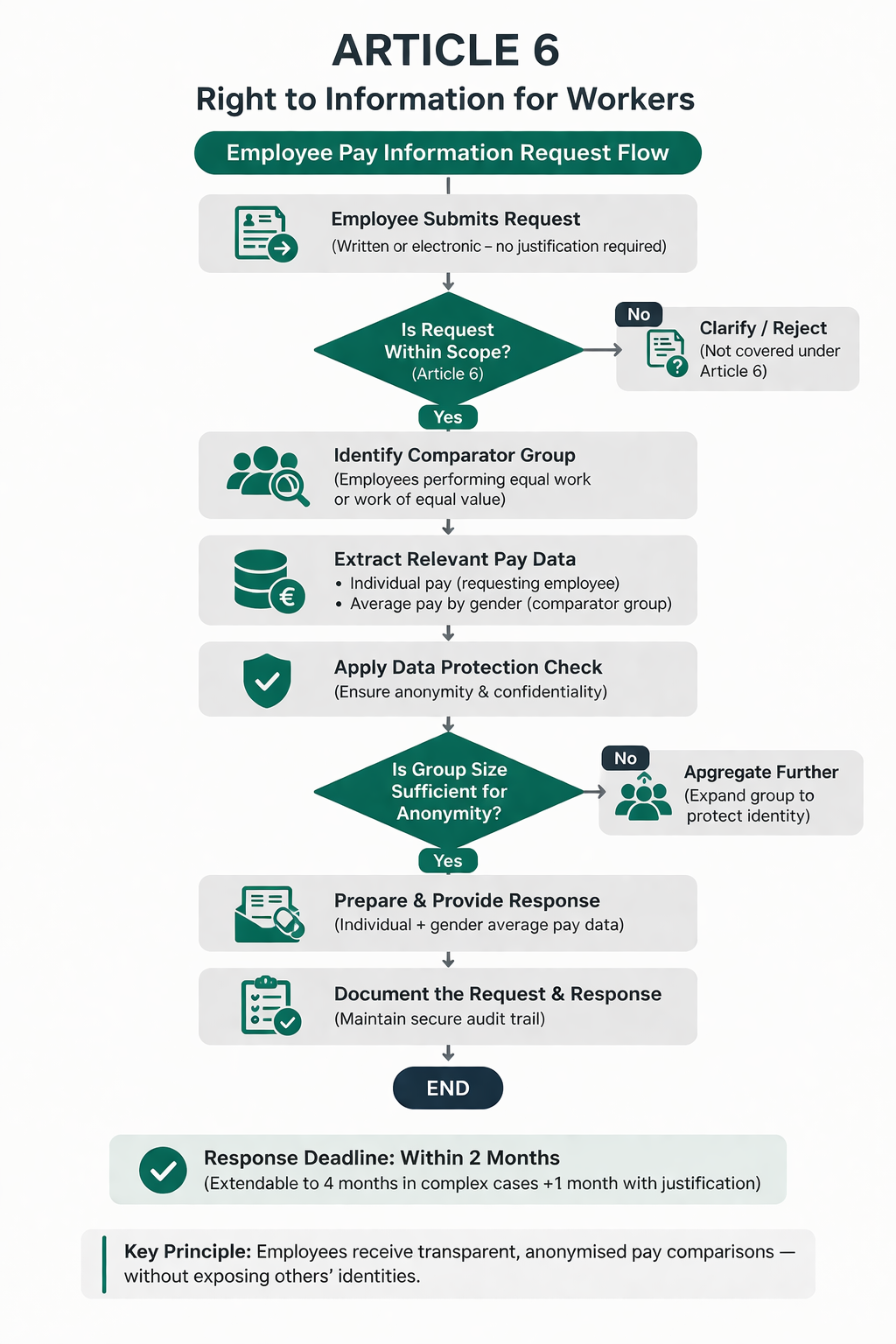
Article 6 Information Request Flow
This flow highlights the importance of structured processes, from request validation to data extraction, anonymisation, and response documentation.
Common Pitfalls and Risks
Inadequate Data Structures
Disorganised or fragmented data makes it impossible to extract the required information accurately or within a reasonable timeframe.
Poorly Defined Comparator Groups
Inconsistent grouping across departments or lack of objective criteria can undermine the validity of responses and increase legal risk.
Data Privacy Violations
Disclosing identifiable information or failing to aggregate data appropriately can constitute a GDPR breach alongside the Directive violation.
Inconsistent Responses
Different responses to similar requests, or a lack of standardisation, can create internal contradictions and expose employers to scrutiny.
Strategic Implications of Article 6
Increased Employee Awareness
Employees gain:
- Greater visibility into pay structures
- Ability to assess fairness
Greater Accountability
Employers must ensure that:
- Pay decisions are explainable
- Differences can be justified
Foundation for Further Obligations
Article 6 supports:
- Part 3: Article 7 — Gender pay gap reporting
- Part 4: Article 8 — Joint pay assessments
- Part 6: Article 10 — Enforcement mechanisms
Key Takeaways
- Article 6 establishes a formal right for employees to access pay information
- Employers must provide individual and comparative pay data
- Data must be accurate, anonymised, and gender-disaggregated
- The primary challenge lies in data readiness and role classification
- Structured processes are essential for consistent compliance
Ready to handle Article 6 information requests?
GenderGov™ helps organisations structure pay data, define comparator groups, and build the documentation needed to respond to employee requests with confidence.
Talk to Us