From Internal Transparency to Public Accountability
Following the introduction of pay transparency in recruitment (Article 5) and employee access to pay data (Article 6), the EU Pay Transparency Directive (Directive (EU) 2023/970) moves into a more structured and externally visible phase under Article 7 — gender pay gap reporting.
This provision requires organisations to calculate, document, and in many cases publish gender pay gap data using a defined set of metrics. It represents a shift from internal transparency to formalised accountability, where pay disparities are no longer internal matters but subject to regulatory and, in some cases, public scrutiny.
What Article 7 Requires — A Detailed Overview
Article 7 establishes reporting obligations for employers above certain workforce thresholds. While specific thresholds and timelines may vary based on national implementation, the Directive provides a clear framework for what must be reported.
Core Reporting Requirements
Employers must calculate and report:
- Gender pay gaps across defined metrics
- Differences in variable pay components (such as bonuses)
- Distribution of men and women across pay quartiles
- Proportion of employees receiving variable pay
These metrics must be calculated using standardised methodologies to ensure comparability.
Employer Thresholds and Reporting Frequency
The Directive introduces a phased approach based on organisation size.
250+
employees
Annual reporting
150–249
employees
Reporting every three years
100–149
employees
Reporting every three years (with later implementation timelines)
Member States may adjust thresholds, but the underlying structure remains consistent.
The Seven Core Pay Gap Metrics
At the heart of Article 7 are the required metrics. These provide a multidimensional view of gender pay disparities.
Gender pay gap reporting is not a single metric, but a combination of indicators capturing different dimensions of pay inequality.
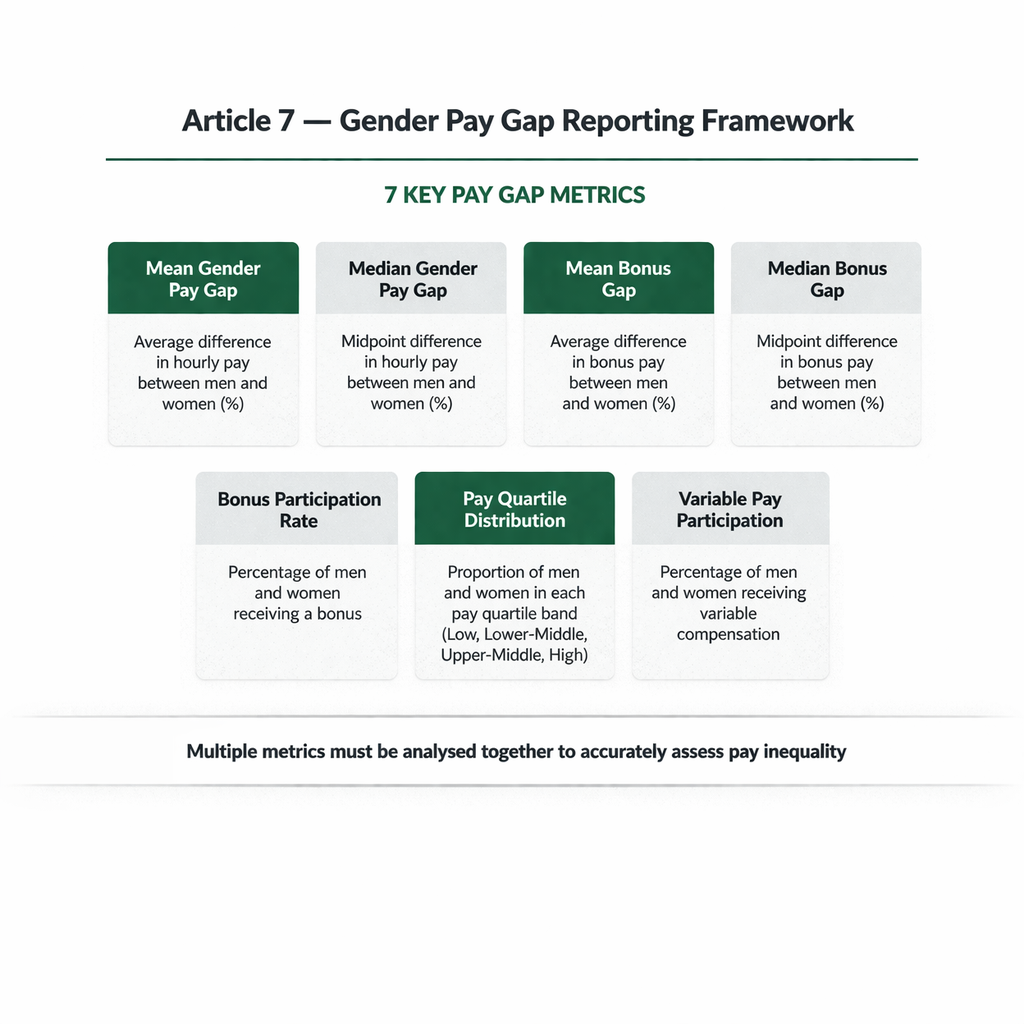
Mean Gender Pay Gap
Difference between the average pay of male and female employees. Sensitive to outliers; reflects overall pay distribution.
Median Gender Pay Gap
Difference between the median pay of male and female employees. Less influenced by extreme values; provides a central comparison point.
Mean Bonus Pay Gap
Difference in average bonus payments between men and women.
Median Bonus Pay Gap
Difference in median bonus payments between men and women.
Proportion Receiving Bonuses
The percentage of men and women receiving variable pay.
Pay Quartile Distribution
Distribution of employees across four pay quartiles — revealing representation patterns across pay levels:
- Lower quartile
- Lower-middle quartile
- Upper-middle quartile
- Upper quartile
Proportion Receiving Variable Pay
The percentage of employees receiving bonuses or variable compensation.
Why Multiple Metrics Matter
A single pay gap figure does not provide sufficient insight into pay inequality.
Example
An organisation may have a low median pay gap but a high concentration of men in senior roles. This would mask structural inequality — one that would only be visible through quartile distribution data.
Article 7 addresses this by requiring a multi-metric approach.
Data Requirements and Preparation
To meet Article 7 obligations, organisations must ensure:
Data Completeness
- All employees included
- Consistent definitions of pay
Data Accuracy
- Up-to-date payroll information
- Correct classification of pay components
Data Consistency
- Standardised methodologies across reporting periods
- Alignment across departments
Key Challenge — Defining "Pay"
The Directive includes multiple components within the definition of pay:
- Base salary
- Bonuses
- Allowances
- Benefits (where applicable)
Organisations must:
- Clearly define what is included
- Apply definitions consistently
Calculating the Gender Pay Gap — Methodological Considerations
Mean vs Median
- Mean reflects overall distribution
- Median reflects central tendency
Both are required to provide a balanced view.
Full-Time Equivalent (FTE) Adjustments
To ensure comparability:
- Part-time salaries must be adjusted
- Pay must be normalised
Treatment of Bonuses
- Must be calculated separately
- Must be included in total compensation analysis
Publication and Transparency
Depending on national implementation:
- Data may need to be published publicly
- Or submitted to regulatory authorities
In both cases, organisations must ensure accuracy, consistency, and clarity.
Identifying and Interpreting Pay Gaps
Article 7 does not prohibit pay gaps. Instead, it requires identification, measurement, and explanation.
When Is a Pay Gap Problematic?
A pay gap may indicate:
- Occupational segregation
- Unequal progression opportunities
- Biased pay practices
When Is It Not Necessarily Non-Compliant?
A pay gap may exist due to:
- Workforce composition
- Seniority distribution
- Market-driven factors
Organisations must always be able to explain the gap and justify differences using objective criteria.
Link to Article 8 — Joint Pay Assessments
If a gender pay gap exceeds 5% and cannot be justified, organisations may be required to conduct a joint pay assessment, work with employee representatives, and identify corrective actions.
This makes accurate reporting critical — outcomes directly trigger further obligations under Article 8.
Practical Implementation — A Step-by-Step Approach
Define Reporting Scope
- Identify employees to be included
- Confirm reporting thresholds
Structure Pay Data
- Consolidate payroll data
- Standardise pay definitions
Calculate Metrics
- Apply required formulas
- Validate outputs
Analyse Results
- Identify patterns and gaps
- Assess potential causes
Prepare Documentation
- Document methodology
- Record assumptions and definitions
Common Pitfalls and Risks
Inconsistent Data Definitions
Different interpretations of pay components or lack of standardisation across departments create unreliable outputs.
Poor Data Quality
Missing or outdated payroll data and incorrect classifications undermine the accuracy of reported metrics.
Misinterpretation of Results
Over-reliance on a single metric or failure to consider structural factors can lead to misleading conclusions and inadequate responses.
Lack of Documentation
Inability to explain methodology or assumptions significantly increases risk during regulatory audits.
Strategic Implications of Article 7
Increased Transparency
Internal and external visibility of pay structures becomes the new baseline.
Greater Scrutiny
- From regulators
- From employees
- From the public (where applicable)
Organisational Impact
- Pressure to address disparities
- Need for structured pay frameworks
Key Takeaways
- Article 7 introduces mandatory gender pay gap reporting
- Employers must calculate multiple metrics, not a single figure
- Data must be accurate, consistent, and well-documented
- Pay gaps must be explained and justified where necessary
- Reporting outcomes may trigger further obligations under Article 8
Ready to structure your pay gap reporting?
GenderGov™ helps organisations calculate all seven required metrics, structure pay data for reporting, and build the documentation needed to explain and defend results.
Talk to Us