Setting the Tone for Fair Pay — Before Day One
The EU Pay Transparency Directive (Directive (EU) 2023/970) introduces a structural shift in how organisations approach pay transparency across the employment lifecycle. While much attention has been placed on reporting obligations and employee rights, Article 5 brings transparency into the earliest stage of the employment relationship — recruitment.
This provision fundamentally changes how employers communicate compensation to candidates. It reduces information asymmetry, limits discretionary practices, and requires organisations to anchor pay decisions in structured, explainable, and gender-neutral frameworks.
For many organisations, Article 5 is not simply a compliance requirement — it is the entry point into broader pay governance transformation.
What Article 5 Requires — A Technical Overview
Article 5 establishes three core obligations that apply during the hiring process:
1. Disclosure of Pay Information to Applicants
Employers must provide candidates with:
- The initial pay level, or
- The pay range applicable to the role
This information must:
- Be based on objective and gender-neutral criteria
- Be provided in advance of the interview
This ensures that candidates enter the recruitment process with a clear understanding of expected compensation.
2. Timing and Method of Disclosure
The Directive allows flexibility in how pay information is communicated, but requires that it be provided:
- In the job vacancy notice, or
- Before the interview stage
In practice, this is expected to result in widespread adoption of salary ranges in job advertisements, particularly as Member States transpose the Directive into national law.
3. Prohibition of Pay History Questions
Employers are prohibited from:
- Asking about a candidate's current salary
- Requesting past compensation history
- Using previous pay as a basis for determining new pay
This provision directly addresses structural drivers of gender pay inequality and shifts the focus toward role-based and market-aligned compensation frameworks.
The Underlying Objective — Eliminating Information Asymmetry
Article 5 is designed to correct a long-standing imbalance in recruitment processes:
- Employers typically possess detailed knowledge of compensation structures
- Candidates often enter negotiations with limited or no visibility
This imbalance can lead to:
- Unequal negotiation outcomes
- Reinforcement of existing pay gaps
- Inconsistent compensation practices
By requiring upfront disclosure, the Directive ensures that:
- Candidates are informed participants
- Compensation decisions are anchored in structured logic
- Organisations move toward more consistent pay practices
What "Objective and Gender-Neutral Criteria" Requires in Practice
One of the most critical elements of Article 5 is the requirement that pay be based on objective, gender-neutral criteria. This is not merely a conceptual requirement — it has direct operational implications.
Key Characteristics of Compliant Criteria
A robust pay framework typically includes:
- Defined job responsibilities
- Required qualifications and competencies
- Experience levels
- Market benchmarking data
- Performance-related factors
These criteria must be:
- Clearly documented
- Applied consistently across roles
- Free from direct or indirect gender bias
Indicators of Risk or Non-Compliance
Organisations may face compliance risks where:
- Compensation decisions are driven by manager discretion without structure
- Pay ranges are not formally defined or documented
- Similar roles are compensated differently without justification
- Recruitment decisions rely heavily on negotiation outcomes
If an organisation cannot clearly explain how a salary range was determined, it is unlikely to meet the expectations of Article 5.
Structural Challenges in Implementation
Although Article 5 appears straightforward, its implementation often reveals deeper organisational gaps.
1. Absence of Formal Pay Structures
Many organisations, particularly SMEs, operate with:
- Informal or loosely defined pay bands
- Role-specific or manager-driven compensation decisions
- Limited documentation of pay logic
This creates immediate challenges when required to disclose salary ranges externally.
2. Internal Pay Inconsistencies
Introducing transparency at the recruitment stage may expose:
- Pay differences across employees performing similar roles
- Historical pay decisions that lack clear justification
- Compression issues between new hires and existing employees
As a result, Article 5 often acts as a trigger for internal pay review and alignment.
3. Shifting Candidate Expectations
Transparent salary communication changes candidate behaviour:
- Candidates are better informed
- Negotiation dynamics become more structured
- Employer credibility becomes closely tied to pay transparency
Organisations may experience:
- Increased scrutiny of compensation ranges
- Greater sensitivity to perceived inequities
- Stronger expectations of fairness and consistency
Operational Impact Across Functions
Article 5 requires coordinated changes across multiple organisational functions.
Recruitment & Talent Acquisition
- Standardisation of job descriptions
- Inclusion of salary ranges in job postings
- Removal of salary history questions
- Training recruiters on compliant communication
HR & Compensation
- Development or refinement of pay bands
- Alignment of roles across departments
- Documentation of pay criteria and decision logic
Legal & Compliance
- Review of hiring policies and practices
- Ensuring compliance with Directive requirements
- Preparing documentation for potential scrutiny
Leadership
- Defining compensation philosophy
- Balancing transparency with market competitiveness
- Managing risks related to internal equity
Practical Implementation — A Step-by-Step Approach
Organisations approaching Article 5 for the first time may benefit from a structured implementation process.
Define Job Families and Role Structures
- Group roles based on function and level
- Identify categories of "equal work" or "work of equal value"
Establish Salary Ranges
- Define minimum, midpoint, and maximum levels
- Use a combination of internal data and market benchmarks
- Ensure consistency across comparable roles
Document Pay Criteria
- Define the factors that influence pay positioning within a range
- Ensure criteria are objective and consistently applied
Update Recruitment Processes
- Revise job posting templates
- Remove salary history questions
- Train hiring managers and recruiters
Review Internal Pay Alignment
- Identify significant inconsistencies
- Prioritise high-risk roles or areas
- Plan adjustments where necessary
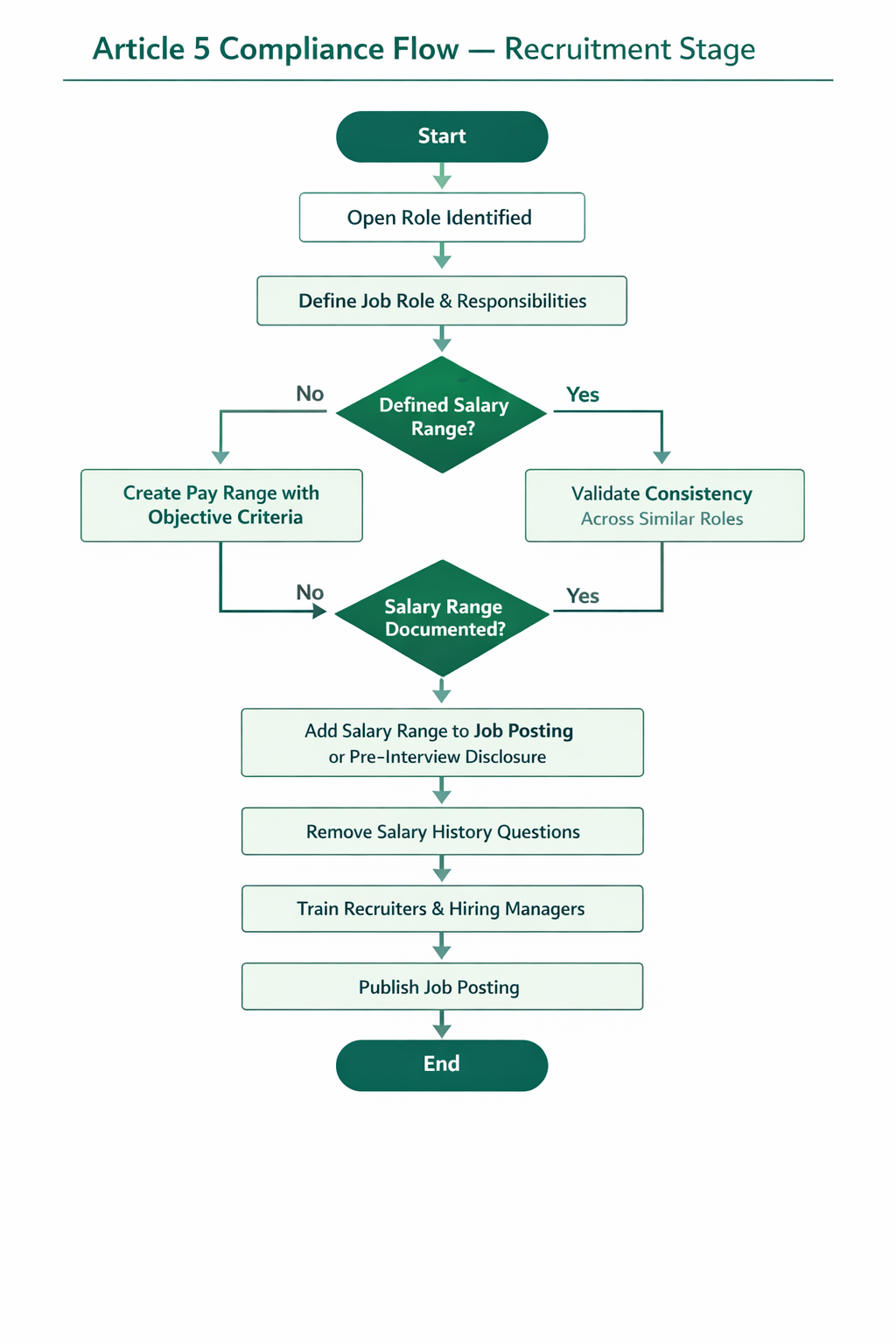
Article 5 Compliance Flow — Recruitment Stage
Compliance is not a single action, but a structured sequence involving role definition, pay range validation, documentation, and recruitment process alignment.
Common Pitfalls and Implementation Risks
Treating Article 5 as a Job Posting Requirement Only
Focusing solely on adding salary ranges to job ads can lead to poorly defined or inconsistent ranges, increased exposure to employee queries, and weak compliance foundations.
Publishing Overly Broad Salary Ranges
Ranges that are too wide may undermine transparency, reduce candidate trust, and raise questions about internal consistency.
Ignoring Internal Equity Before External Disclosure
Failure to address internal inconsistencies may lead to employee dissatisfaction, trigger formal information requests under Article 6, and increase organisational risk.
Lack of Documentation
Without proper documentation, organisations may struggle to justify pay decisions, respond to challenges, and demonstrate compliance.
Strategic Implications of Article 5
Beyond compliance, Article 5 introduces broader organisational implications.
Strengthening Employer Credibility
Transparent pay practices contribute to:
- Greater trust among candidates
- Improved employer reputation
- More consistent hiring experiences
Improving Hiring Efficiency
Clear salary communication can:
- Reduce misaligned applications
- Streamline recruitment processes
- Minimise negotiation-related delays
Enabling Future Compliance
Article 5 forms the foundation for subsequent obligations, including:
- Part 2: Article 6 — Employee rights to pay information
- Part 3: Article 7 — Gender pay gap reporting
- Part 4: Article 8 — Joint pay assessments
Organisations that establish structured pay frameworks early are better positioned to meet these requirements efficiently.
Key Takeaways
- Article 5 introduces mandatory pay transparency at the recruitment stage
- Employers must disclose salary ranges based on objective, gender-neutral criteria
- Salary history questions are prohibited
- The primary challenge lies in internal pay structure readiness
- Early preparation supports both compliance and long-term pay governance
Preparing for Article 5 compliance?
GenderGov™ helps organisations structure pay data, build defensible salary frameworks, and prepare for regulatory scrutiny before 2026 deadlines.
Talk to Us