Balancing Transparency with Privacy
The EU Pay Transparency Directive (Directive (EU) 2023/970) significantly expands access to pay-related information through Articles 5 to 8. However, this expansion raises a critical question: how can organisations increase transparency without violating employee privacy?
Article 9 addresses this intersection between pay transparency and data protection, ensuring that the Directive operates in alignment with the General Data Protection Regulation (GDPR).
It establishes that while transparency is essential, it must not come at the cost of exposing identifiable personal data.
The Core Principle — Transparency Within Legal Boundaries
Article 9 does not introduce entirely new data protection rules. Instead, it reinforces that all pay-related disclosures must comply with existing GDPR principles, and that transparency obligations must be implemented in a way that protects individual privacy.
Obligation
Provide meaningful pay information to employees and regulators as required by the Directive
Constraint
Prevent identification of individual employees through any disclosed data
Key GDPR Principles Relevant to Article 9
To understand Article 9, it is essential to consider the underlying GDPR framework.
Data Minimisation
Only the minimum necessary data should be disclosed.
- Avoid sharing excessive or granular data
- Limit disclosures to what is required under the Directive
Purpose Limitation
Pay data must be used only for:
- Transparency and compliance purposes
- Not for unrelated or secondary uses
Lawfulness, Fairness, and Transparency
Data processing must:
- Have a lawful basis
- Be fair to employees
- Be clearly communicated
Confidentiality and Integrity
Employers must ensure:
- Secure handling of pay data
- Protection against unauthorised access or disclosure
What Can Be Disclosed Under the Directive
To comply with Articles 6 and 7, employers must provide certain categories of information.
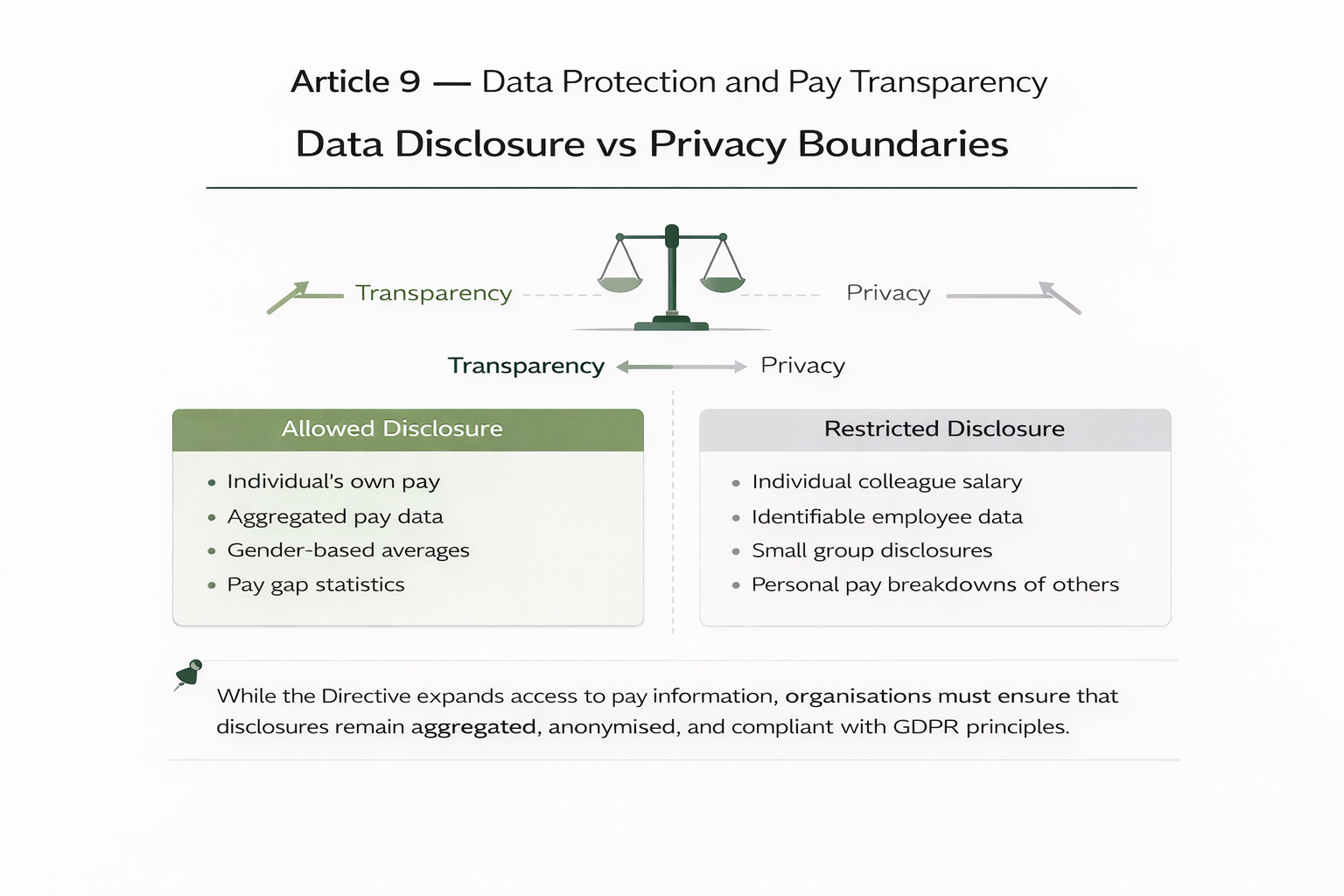
Permissible Disclosures
- Individual employee's own pay information
- Average pay levels for comparator groups
- Gender-disaggregated data
- Aggregated statistics (e.g., pay gaps)
Compliant when presented in aggregated form and individual identities cannot be inferred.
What Cannot Be Disclosed
- Individual salaries of identifiable colleagues
- Data that allows indirect identification of individuals
- Small-group data where identities can be inferred
The Challenge of Small Comparator Groups
One of the most complex aspects of Article 9 arises when comparator groups are small.
Example Scenario
If a comparator group consists of one male employee and one female employee, providing average pay data effectively reveals individual salaries — a clear GDPR violation.
Required Approach
- Aggregate data across larger groups, or
- Withhold disclosure where anonymity cannot be ensured
This requires careful judgement and clear internal guidelines established in advance.
Article 9 Decision Framework — Disclosure vs Privacy
When deciding whether to disclose pay data, organisations should apply this logic:
Is the data required under the Directive?
Can it be aggregated or anonymised sufficiently?
Does the group size prevent individual identification?
Proceed with disclosure
|Withhold or further aggregate
Interaction with Article 6 — Employee Information Requests
Article 6 gives employees the right to request pay information. Article 9 ensures that responses to such requests remain compliant with GDPR and that employers do not disclose excessive or identifying information.
Practical Implications
When responding to employee requests:
- Provide aggregated and anonymised data
- Avoid sharing individual-level comparisons
- Apply consistent thresholds for disclosure
Lawful Basis for Processing Pay Data
Under GDPR, organisations must identify a lawful basis for processing personal data.
Legal Obligation
Compliance with the Directive provides a direct legal basis for processing pay data for reporting purposes.
Legitimate Interest
Ensuring fair pay practices may also constitute a legitimate interest where processing goes beyond strict legal requirements.
Employers must:
- Document their chosen legal basis
- Ensure consistency in application
Transparency Toward Employees
Employers must inform employees about:
- How their pay data is used
- What information may be disclosed
- How privacy is protected
This is typically done through:
- Privacy notices
- Internal policies
Data Security Requirements
Organisations must ensure that pay data is stored securely, access-controlled, and protected against breaches.
Role-Based Access
Restrict compensation data to authorised personnel only
Encryption
Encrypt sensitive information at rest and in transit
Regular Audits
Conduct periodic reviews of data access logs and permissions
Documentation and Accountability
Article 9 reinforces the need for:
- Clear documentation of data handling practices
- Defined protocols for disclosure
- Records of decisions made in borderline cases
Practical Implementation — A Step-by-Step Approach
Map Pay Data
- Identify where pay data is stored
- Understand data flows within the organisation
Define Disclosure Rules
- Establish what can be shared
- Define thresholds for aggregation
Align with GDPR Requirements
- Identify lawful basis for processing
- Update privacy notices
Implement Safeguards
- Ensure anonymisation processes are in place
- Restrict access to sensitive data
Train HR and Management
- Ensure understanding of disclosure limits
- Prepare teams to handle requests appropriately
Common Pitfalls and Risks
Over-Disclosure
Sharing too much information increases the risk of individual identification and constitutes a GDPR breach alongside a Directive violation.
Under-Disclosure
Failing to meet transparency obligations by providing insufficient information exposes the organisation to Directive non-compliance.
Inconsistent Application
Different approaches across departments or lack of standardisation creates internal contradictions that increase regulatory risk.
Weak Data Governance
Poor data security practices and lack of clear accountability undermine both GDPR compliance and Directive obligations simultaneously.
Strategic Implications of Article 9
Stronger Data Governance
- Strengthen data management practices
- Align HR and legal functions
Clear Internal Policies
- Standardised disclosure protocols
- Defined responsibilities
Balancing Competing Priorities
- Transparency vs privacy
- Compliance vs operational practicality
Link to Enforcement
Failure to comply with data protection requirements may result in:
- GDPR-related penalties
- Regulatory scrutiny
- Reputational risk
Data protection failures do not exist in isolation. A breach of Article 9 can simultaneously constitute a GDPR violation and Directive non-compliance, compounding enforcement exposure under Article 10.
Key Takeaways
- Article 9 ensures that pay transparency is implemented within GDPR boundaries
- Employers must balance data disclosure with employee privacy
- Only aggregated and anonymised data should be shared
- Small group disclosures present significant risk
- Strong data governance and documentation are essential
Ready to align pay transparency with data protection?
GenderGov™ helps organisations define disclosure rules, implement anonymisation thresholds, and build the data governance structures needed to meet both Directive and GDPR obligations simultaneously.
Talk to Us