From Reporting to Remediation
While Article 7 introduces structured gender pay gap reporting, the EU Pay Transparency Directive (Directive (EU) 2023/970) does not stop at measurement. Article 8 establishes what must happen when pay disparities are identified and cannot be justified.
This provision introduces the concept of a joint pay assessment, requiring employers to move beyond reporting into structured investigation and corrective action, in collaboration with worker representatives.
Article 8 therefore represents a critical shift from transparency to accountability and remediation.
What Article 8 Requires — A Detailed Overview
A joint pay assessment must be conducted when specific conditions are met.
Core Trigger Conditions
Employers are required to initiate a joint pay assessment where:
A gender pay gap of at least 5% exists within a category of workers
The gap cannot be justified based on objective, gender-neutral criteria
The gap has not been remedied within a reasonable period of time
All three conditions must be considered together. No single condition alone automatically triggers a joint pay assessment.
Understanding the 5% Threshold
The 5% threshold is not, by itself, an automatic trigger.
Common Misconception
A pay gap above 5% automatically implies non-compliance and triggers immediate corrective action.
The Correct Interpretation
A gap above 5% acts as a signal for further analysis. The key question is whether the difference can be explained using objective, gender-neutral factors.
Objective Justification — What It Requires
Employers must be able to demonstrate that pay differences are based on:
- Experience and seniority
- Performance-related factors
- Skills and qualifications
- Market-related considerations
These justifications must be:
- Documented
- Consistently applied
- Free from bias
If justification is not possible, further action is required.
Article 8 Decision Logic
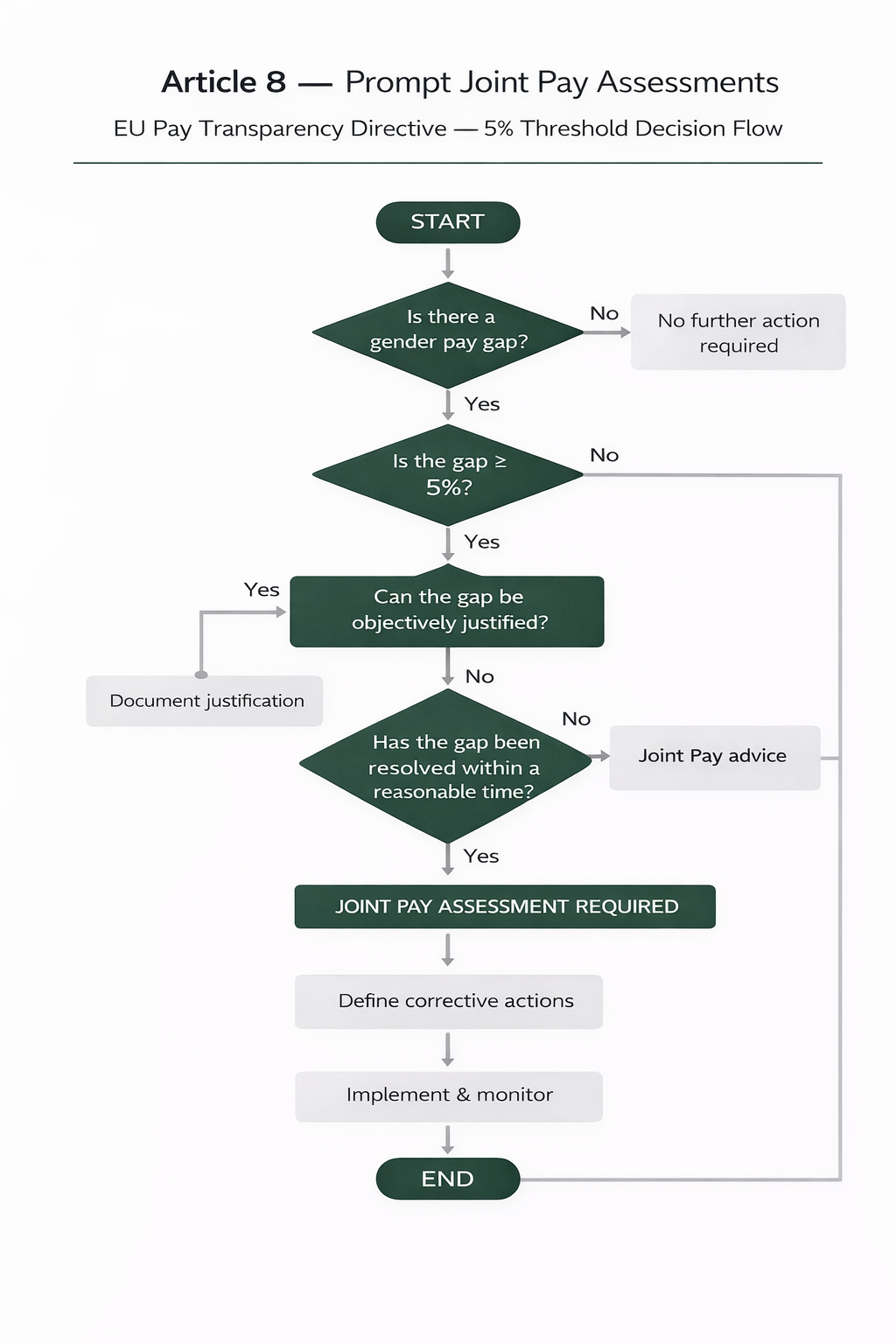
When Is a Joint Pay Assessment Required?
Pay gap exceeds 5% in a category of workers
Gap lacks objective, gender-neutral justification
Gap remains unresolved over time
Joint pay assessment must be initiated
What Is a Joint Pay Assessment?
A joint pay assessment is a structured review conducted by the employer together with worker representatives (such as employee representatives or unions).
It aims to:
- Identify the causes of pay disparities
- Evaluate pay structures and practices
- Define corrective actions
Scope of the Assessment
The joint pay assessment must cover five key areas:
Analysis of Pay Structures
- Review of pay levels across roles
- Identification of inconsistencies
Evaluation of Job Classification Systems
- Assessment of how roles are defined
- Verification that classifications are gender-neutral
Identification of Pay Differences
- Analysis of gaps within comparable roles
- Examination of patterns across departments
Review of Pay Progression
- Evaluation of promotion and progression systems
- Identification of potential barriers
Examination of Variable Pay
- Review of bonus structures
- Assessment of distribution across genders
Role of Worker Representatives
A defining feature of Article 8 is the requirement for joint participation.
Why This Matters
- Ensures transparency in the assessment process
- Introduces independent oversight
- Enhances credibility of findings
Practical Implications
Employers must:
- Engage with employee representatives
- Share relevant data
- Collaborate on identifying solutions
Corrective Measures — Moving Beyond Analysis
The outcome of a joint pay assessment must include three defined components:
1. Identification of Root Causes
- Structural issues in pay systems
- Bias in progression or reward mechanisms
2. Definition of Remedial Actions
- Adjustments to pay levels
- Changes to policies and practices
- Improvements in role classification
3. Implementation Plan
- Timeline for corrective actions
- Assignment of responsibilities
- Monitoring mechanisms
Documentation and Reporting Requirements
Employers must document:
- Findings of the assessment
- Methodology used
- Actions taken
This documentation may be subject to:
- Regulatory review
- Employee scrutiny
Key Challenge — Identifying "Unjustified" Pay Gaps
One of the most complex aspects of Article 8 is determining when a pay gap cannot be justified.
Challenges Include
- Lack of clear documentation
- Inconsistent application of criteria
- Over-reliance on subjective factors
Example
If two employees in similar roles have different pay due to informal negotiation outcomes, this may not qualify as objective justification under the Directive — even if it reflects historical practice.
Practical Implementation — A Step-by-Step Approach
Identify Pay Gaps
- Use Article 7 reporting data
- Focus on categories with gaps above 5%
Assess Justification
- Evaluate whether gaps can be explained
- Document supporting evidence
Monitor Over Time
- Determine whether gaps persist
- Track remediation efforts
Initiate Joint Assessment (if required)
- Engage worker representatives
- Define scope and methodology
Conduct Analysis
- Review pay structures and practices
- Identify root causes
Define and Implement Actions
- Develop corrective measures
- Monitor outcomes
Common Pitfalls and Risks
Treating the 5% Threshold as Automatic Non-Compliance
This leads to unnecessary escalation and misinterprets the Directive's intent. The threshold is a signal, not a verdict.
Inadequate Documentation
Weak justification for pay differences significantly increases risk during assessments and regulatory review.
Lack of Structured Methodology
Inconsistent analysis reduces the credibility of findings and may fail to satisfy regulatory requirements.
Limited Engagement with Worker Representatives
Reduced transparency and lack of collaborative process can lead to disputes and undermine the validity of the assessment.
Strategic Implications of Article 8
Increased Accountability
- Organisations must move beyond reporting
- Action required where gaps exist
Strengthened Governance
- Greater structure in pay decisions
- Improved documentation standards
Cultural Impact
- Increased awareness of pay fairness
- Greater employee trust where implemented effectively
Link to Enforcement
Failure to address unjustified pay gaps may:
- Lead to legal challenges
- Trigger regulatory action
- Result in penalties under Article 10
The enforcement mechanisms under Article 10 are directly linked to outcomes under Article 8. Organisations that fail to act on identified gaps face compounding compliance risk.
Key Takeaways
- Article 8 introduces mandatory corrective action mechanisms
- A joint pay assessment is required when a 5% gap is unjustified and unresolved
- Employers must collaborate with worker representatives
- The focus is on identifying root causes and implementing solutions
- Strong documentation and structured processes are critical
Ready to prepare for joint pay assessments?
GenderGov™ helps organisations identify unjustified pay gaps, build the documentation needed to justify pay differences, and structure the assessment process to meet Article 8 requirements.
Talk to Us